Right now, it can feel like your whole mind is open to you. Stay with that feeling for a second. How many separate things are actually in it, at this exact moment?
Try to hold them all at once. A number someone just read out. The shape of the room. The sentence you were about to say. That argument from an hour ago that still stings. You can turn to each one, but you can’t keep them all lit together. Something slips out the moment something else arrives.
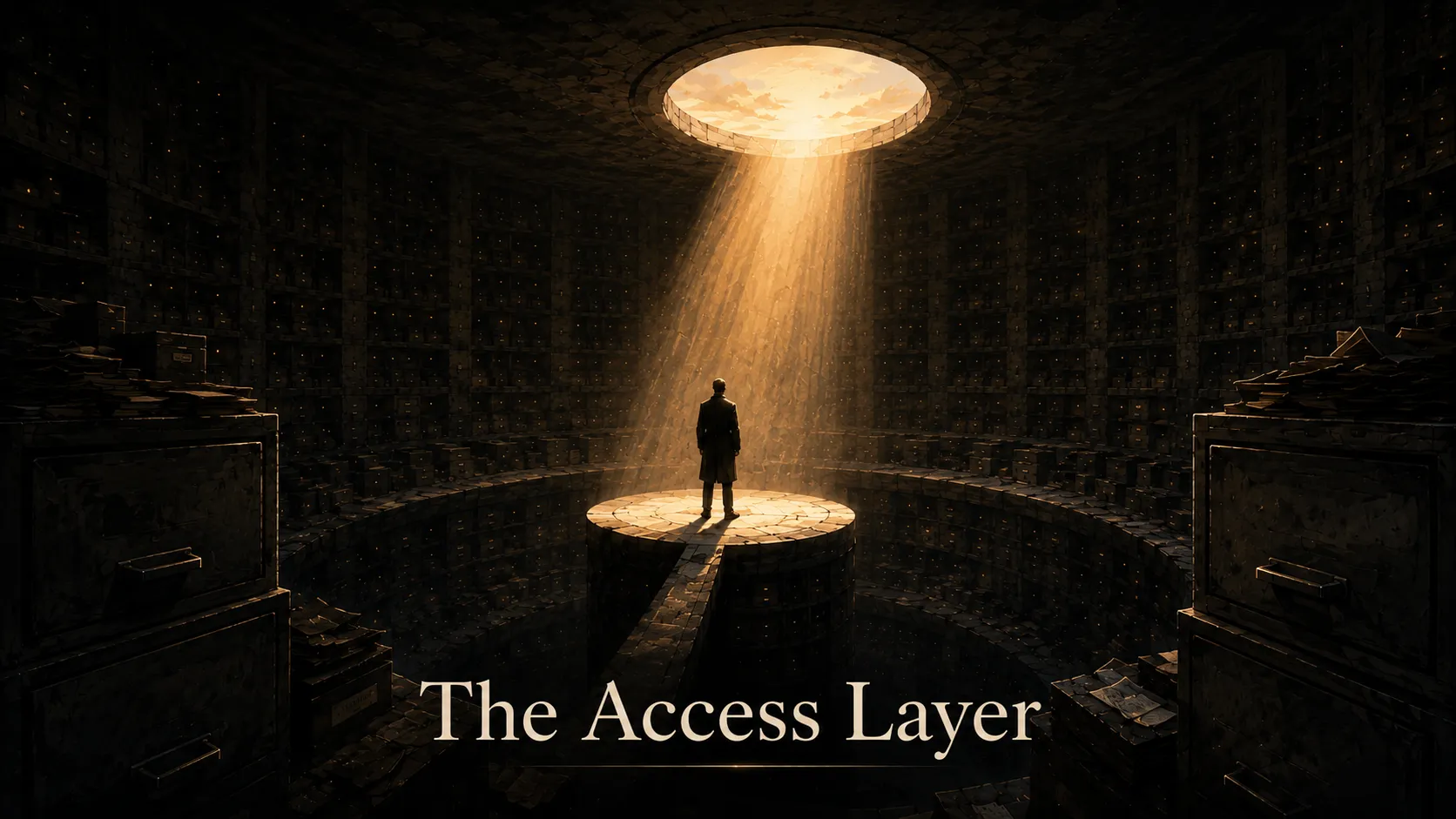
Here’s a way to picture it. Your mind is a dark warehouse, vast and mostly stored away. Consciousness is a headlamp. Wherever you point it, there’s light. So it feels like the whole warehouse is lit. But the beam is small. It only ever covers a little at a time. The instant you turn to check whether some corner is lit, your turning is what lights it. You never catch the dark. You might sense, dimly, where things are kept out there. But it’s the beam that hands something up to you, ready to name, use, and act on. The light isn’t just showing you the warehouse. For anything you can report, reason with, or act on, the beam is the part you actually get to use.
That’s the claim I want to sit with. The warehouse isn’t empty. But the you who feels continuously, richly aware is working from the moving beam. And the beam is narrow.
The argument in brief
- This essay is about access consciousness: what becomes available for report, reasoning, memory, and deliberate action. It does not attempt to explain why experience feels like anything from the inside.
- The usable part of awareness appears to be narrow. Only a small number of selected states can occupy the mental workspace at once, while most of the machinery producing and selecting them remains inaccessible.
- Awareness feels much wider because attention illuminates whatever we turn toward. The act of checking what is present brings it into the beam, making it difficult to perceive the beam's own limits.
- Global workspace theory offers a plausible account of how selected information becomes widely usable, but important predictions of the theory remain contested. The architectural idea is useful without being settled science.
- AI systems encounter a similar functional problem. They must select a small working context from far more information than they can use at once. That resemblance reflects shared constraints, not evidence that the systems share consciousness.
First, a boundary
Before this goes anywhere, one distinction has to be on the table. The word “consciousness” quietly does two different jobs. If you let them blur, the argument cheats.
Ned Block drew the line in 1995. Access consciousness is information being available. It’s reportable, usable for reasoning, and able to steer what you say and do. Phenomenal consciousness is what it’s like. It’s the raw felt quality of red, of pain, of the room being there at all.
This essay is about access. It’s about what gets into the beam and becomes usable. It doesn’t touch the hard part, the reason there’s anything it’s like to be the lit patch in the first place. I’m not going to pretend to solve that. And you should be suspicious of anyone who slides from one to the other without saying so. Keep the boundary in view the whole way down. When you say you’re conscious of something, which of the two do you actually mean?
One more piece of throat-clearing, because it saves a lot of arguing later. I’m using working memory as a measurable window into access, not as a synonym for consciousness. Working memory, attention, report, and global broadcast are different mechanisms. (Global broadcast is the brain sharing one selected signal widely, so many systems can use it at once.) I’m not claiming they’re one thing. I’m claiming they all point at the same constraint. Only a small slice of the mind becomes usable at once.
The lit patch is small
So how big is the beam?
Working memory is the handful of things you can hold and actually work on right now. Think of it as the mental desk, not everything saved on the drive. For a long time the desk was assumed to be roomy. The famous 1956 figure was seven items, give or take two. Then the number kept shrinking under scrutiny. Once you strip out the rehearsal and grouping tricks, the honest limit lands closer to about four chunks. And a chunk isn’t a fixed unit of information. It can be a single digit. Or it can be the entire weight of “my mother’s disappointment,” compressed and bound into one slot. So the real limit isn’t the raw count. It’s the bandwidth to bind and hold whatever’s in the slots at all.
The cleanest demonstration is almost rude in its simplicity. One classic experiment showed people arrays of colored squares. The experiment hid them briefly, then showed them again, and asked whether anything had changed. Up to about four objects, people were near-perfect. Past that, performance matched a tight limit of roughly four integrated objects. The scene wasn’t indefinitely expandable. In that paradigm, the desk had a hard edge.
One live account in cognitive science treats that bottleneck as part of the architecture, not an accident. What becomes available to report, reason about, and deliberately use may be only a narrow broadcast of a few chunks. Most of the machinery that picks those chunks never enters the broadcast at all.
Four-ish, not four
I have to be careful with that four, because it’s doing rhetorical work it can’t quite cash.
Maybe the limit is a fixed set of boxes. Maybe it’s a pool of attention spread thinner the more you try to hold at once. Maybe it’s just a pile of things interfering with each other. Which one is right is a live fight among the people who study this for a living. So hold the number loosely. Here’s the claim that survives every version of the argument, and the only one I need. The usable channel is small. It stays small no matter which side turns out right.
Why it feels so much bigger
Here’s the obvious objection. Your experience clearly isn’t four squares. You see a whole detailed room, hear the whole street, feel the whole body. How can access be that narrow when awareness feels that wide?
This is the headlamp again. Henry Taylor, writing in Scientific American, gives it a sharper name. He calls it the refrigerator-light illusion. Open the door, and the light’s on. So you assume it’s always on. You never catch it off, because opening the door is what turns it on. Attention does the same thing. Every time you check whether some part of your mind is present to you, the checking drags it into the beam. It’s always there when you look. So you conclude it was there all along.
The seams show when attention is busy elsewhere. One study found that simply walking through a doorway makes people forget what they were holding in mind. It’s as if crossing into a new room resets the desk. And there’s the gorilla experiment everyone now knows. People counting passes in a ball game fail to notice a person in a gorilla suit stroll straight through the middle of the scene and thump its chest.
And the headlamp picture isn’t neutral, so I should say that plainly. It’s the access-first reading of a live fight. It isn’t the settled answer. There’s a serious rival. Maybe experience really does overflow access. Maybe there’s more felt than you can ever report. On that view, the narrowness is only in the reporting, not in the having. Block himself pressed a version of that overflow argument. I’m not going to settle sparse-versus-overflow here, because nobody has. I’m asking the narrower question. If the access layer is as small as the evidence keeps suggesting, what follows?
The workspace, and why it just got harder to tell
Say the beam is narrow. What does the narrow lit part actually do?
The leading functional answer is the global workspace. It was first framed decades ago and later given a neural form. Specialized processors run in parallel all over the brain, mostly in the dark. Consciousness is the shared stage where one winner gets broadcast to all of them at once. That’s what lets it be remembered, spoken, planned with, and acted on. Consciousness on this view isn’t the spark. It’s the moment a local spark becomes something the whole organization can use. A small workspace is exactly what you’d expect a broadcast channel to be. Bandwidth is expensive, and only the winners get on air.
It’s a clean, buildable story. I’d hold it more loosely than I once did. In 2025 a seven-year adversarial collaboration, the Cogitate Consortium, tested it head to head against a rival theory. They reported the results in Nature. Cogitate didn’t kill the global workspace. It made the honest version harder. Here’s precisely how. It bruised the theory’s predictions about brain wiring more than the abstract idea of a workspace. The broad shape of a theory can survive even when one of its specific brain signals fails to show up. Those brain-level predictions took a real hit. The theory predicts ignition, a sharp flare of activity that should fire the moment something flips into awareness. It didn’t appear on cue. The theory also hands a starring role to the prefrontal cortex, the planning-and-control region behind your forehead. That prediction took a hit too. The rival theory failed key predictions of its own. Nobody walked off the field clean.
I’m citing a theory while its central predictions are under fire, and I’m doing it on purpose. That’s where the honest position lives right now. The workspace is a strong, useful, unfinished hypothesis. It is not a settled fact. So the question isn’t whether the broadcast model is proven. It’s what you should make of yourself, given a model this suggestive and this unresolved.
Scarce, selected, and often late
Now put it together.
The lit patch is small. The beam lights whatever it turns toward. So it never sees its own darkness. The mechanism that decides what reaches the light is a broadcast we can sketch but can’t yet confirm. And there’s a fourth thing, carried over from an earlier piece. The light often arrives late. Careful work goes back to Libet. Aaron Schurger and colleagues later reinterpreted it. What looks like a decision is noise accumulating toward a threshold, not a finished unconscious choice. This work suggests conscious access is often not the first event in the chain. It’s the point where a process becomes reportable and available for control. That point arrives late, and it’s always scarce.
So the self you can report from, moment to moment, is the contents of that beam. The self you can speak from isn’t the whole mind. It’s the access layer. And it may be stranger than even that sounds. If the only you that ever shows up is the one assembled in the beam, then the you who feels like it’s holding the headlamp might just be the story the lit patch keeps telling about itself. Daniel Dennett called that a center of narrative gravity. Thomas Metzinger went further. He said there was never anyone holding the light at all. I can’t referee that fight. But notice how hard it is to even pose the question from anywhere except inside the beam.
The machinery that proposed the thought, set the mood, and ranked the options before handing a finished winner up to awareness never shows up in the room where you live. It just delivers.
Three caveats keep this from becoming something it isn’t. Working-memory capacity isn’t the same thing as phenomenal consciousness. Nothing here explains why the beam feels like anything. “Four” isn’t a constant of nature. It’s a rough bottleneck that moves with task, chunking, precision, and interference. And small, selective, and late doesn’t mean useless. A narrow channel is exactly what lets the rest of the system stay specialized and parallel, instead of collapsing into one slow blur. The bottleneck isn’t a bug in the design. It’s part of what lets the design scale.
The part I can’t put down
I’d file all of this under fascinating and move on. Except I spend my working days building AI systems that hit the exact same wall. When you work with an AI assistant, only a small amount of text fits in front of it at any one moment. That’s its beam. The people who build these systems call it the context window. Everything else the system could draw on, whole codebases, documents, the earlier parts of your own conversation, sits outside that window in the dark. It’s far too big to hold all at once. So the system needs something that decides which few pieces to pull into the window for the next step. That’s the same job your attention does when it decides what gets handed up to your headlamp. I didn’t build any of that to imitate a brain. I hit the same constraints a brain hits: too little room, noisy guesses about what to load, a real cost to every action. I made the same trades, because the trades are forced.
Hold the analogy at the right level, though. A context window isn’t working memory. A searchable memory store isn’t an unconscious. A loop of the AI calling tools and reading back the results isn’t a brain. The resemblance is in the function, not the biology. Any system holding more than it can act on at once needs a way to decide what to load in, what to share widely, and what to act on. That resemblance isn’t evidence of consciousness. It’s evidence that resource-limited intelligent systems keep converging on the same bottleneck: the same question of what earns a place in the workspace. I don’t think I’m building conscious systems. I’m just less sure than I used to be that the difference lives where I always assumed it did.
Which is exactly where this series goes next. If being useful and being awake keep reaching for the same architecture, then the interesting question was never whether I accidentally built a mind. It’s narrower and harder. What does any system, wet or silicon, have to select, broadcast, remember, and hand off before we’d trust it to act?