Think about the last decision you made today. What to eat. Whether to answer that text now or later. Which tab to open first.
Do you remember the moment you decided?
Or do you remember the moment you noticed you had already decided?
Most people, when they are honest, find that deciding feels less like commanding and more like discovering. A choice surfaces. A reason arrives with it. The reason feels like it came first.
But did it?
That gap between the decision and your awareness of it turns out to be measurable. And the measurement opens a question that decades of neuroscience, psychology, philosophy, and economics still have not closed.
The timing problem
In 1983, Benjamin Libet asked people to do something simple: flex your wrist whenever you feel like it, and note the exact moment you first became aware of the urge. He measured brain activity with EEG, looking for a slow voltage buildup over motor areas called the readiness potential.
The readiness potential began roughly 550 milliseconds before movement. Subjects reported conscious intention only about 200 milliseconds before movement. Measurable motor preparation was already underway about 350 milliseconds before subjects reported the felt intention to act.
That does not prove the unconscious brain had already made a complete decision. The more careful reading is stranger:
The conscious feeling of deciding appears inside a process already in motion.
Twenty-five years later, Chun Siong Soon, John-Dylan Haynes and colleagues used fMRI and found weak but statistically significant predictive information in frontopolar and parietal regions several seconds before reported awareness. Not milliseconds. Whole seconds.
But this was not cinematic mind-reading. The prediction was probabilistic, not clairvoyant. The scanner detected upstream neural dynamics that leaked information about a future choice.
In 2012, Aaron Schurger and Stanislas Dehaene proposed a major reinterpretation. The readiness potential may not be a specific unconscious decision signal at all. It may be what happens when random fluctuations in neural activity drift toward a threshold. Average many trials backward from movement, and stochastic noise looks like a smooth ramp.
That reinterpretation weakens the cartoon version of Libet. It does not rescue the folk version of conscious will.
In no version of the story does consciousness simply show up first, issue a command, and watch the body obey.
The intracranial evidence sharpens the point. In 2011, Fried, Mukamel, and Kreiman recorded from individual neurons in epilepsy patients with implanted electrodes. Neuronal populations in medial frontal regions shifted before subjects reported awareness of intending to move. Ensemble activity predicted upcoming decisions with high accuracy hundreds of milliseconds before reported awareness.
This is not averaged scalp EEG. It is single-neuron activity in human medial frontal cortex moving toward action before the person says “now I intend.”
The adversarial critique matters, though. Uri Maoz and colleagues tested arbitrary versus deliberate decisions and found that readiness potentials were apparent for arbitrary decisions but absent or much reduced for deliberate ones involving meaningful consequences.
So the defensible conclusion is not “neuroscience has disproved free will.”
The defensible conclusion is that the felt moment of conscious intention is not a reliable timestamp for the beginning of the causal chain.
What does that change about how you think about your own decisions?
The state problem
The timing problem says consciousness may arrive late.
The state problem says the thing consciousness explains may have already been shaped by variables the narrator does not see.
In 2008, John Coates and Joe Herbert went to a London trading floor and measured testosterone and cortisol in real traders at 11 AM and 4 PM, then compared hormone levels with actual profit and loss. Higher morning testosterone was associated with higher daily profitability. Cortisol tracked volatility and risk exposure.
Real traders, real markets, real money.
The lesson is not “testosterone makes people rich.” Hormonal effects are context-dependent, sex-dependent, dose-dependent, and entangled with social status, stress, sleep, and feedback. The stronger claim is this:
Choice is state-dependent. The same option is not psychologically the same option under stress, sleep loss, hunger, pain, threat, arousal, or reward anticipation.
George Loewenstein made this point with unusual clarity. Immediately experienced visceral states can crowd out longer-term goals. Worse, people in a “cold” state systematically underestimate how strongly future “hot” states will affect them.
This is the hot-cold empathy gap. You do not merely choose differently when you are hungry, afraid, lonely, or depleted. You also mispredict how different future-you will become under those states.
The Kosfeld, Heinrichs, and Zak oxytocin trust study added another dimension. Administer a neuropeptide and people hand over more of their own money to strangers in an economic game. They do not report feeling different. They do not notice anything has changed. They simply trust more, and then they explain why they trusted, as if the explanation came first.
Molecules do not issue commands. They tilt landscapes. They change which options feel salient, safe, urgent, disgusting, attractive, or worth the risk.
Your narrator rarely says “I selected this option because interoceptive load, endocrine state, and reward prediction made it feel locally optimal.”
It says “I just thought it was the right move.”
If a molecule you did not choose, released on a schedule you did not set, can rewrite how much risk you take with real money on a Tuesday afternoon, where does your personality end and your biochemistry begin?
The preference problem
This is where behavioral economics becomes not just relevant but necessary.
Neuroscience challenges the timing of conscious authorship. State-dependent research challenges the neutrality of the chooser. Behavioral economics challenges the stability of the thing being chosen: preference itself.
Daniel Kahneman spent decades with Amos Tversky mapping how human judgment actually works. In Thinking, Fast and Slow, he organized the findings into a framework that belongs at the center of this argument: System 1 and System 2. System 1 is fast, automatic, associative, effortless. System 2 is slow, deliberate, serial, costly. Kahneman’s own summary: “System 2 believes itself to be where the action is. But the automatic System 1 is the hero of the book.”
Does that sound familiar?
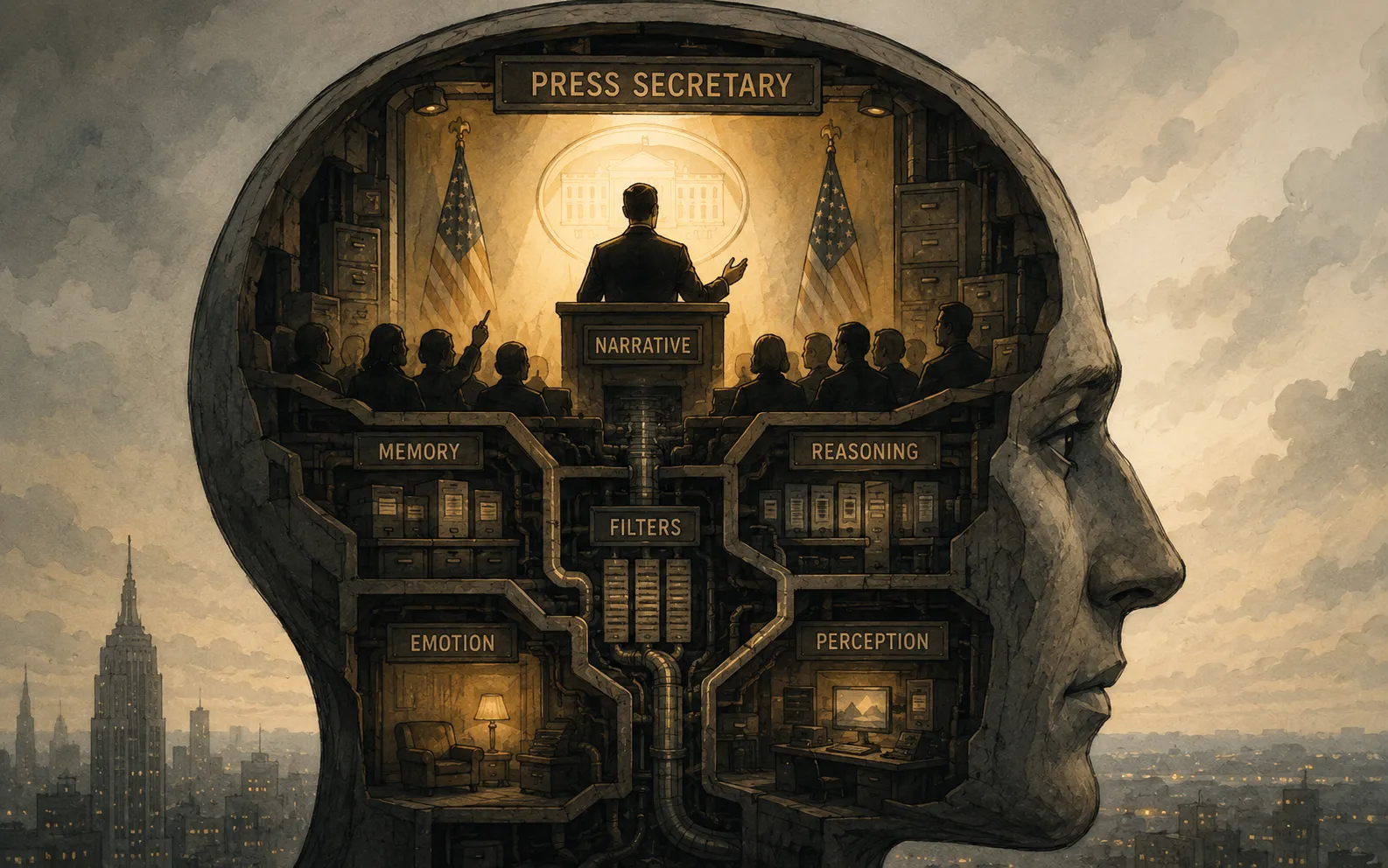
System 1 does most of the deciding. System 2 thinks it is in charge but is mostly endorsing, rationalizing, and occasionally vetoing. That is the press secretary argument in cognitive science language. The narrator is System 2, drafting the official statement about what System 1 already decided.
What Kahneman and Tversky documented empirically across decades of research, the neuroscience of consciousness is confirming at a different level of analysis. Libet, Fried, Gazzaniga, the split-brain interpreter: all of it converges on the same structure. System 1 is the unconscious machinery. System 2 is the narrator. The press secretary is System 2.
Herbert Simon had already attacked the fantasy of perfect optimization in “A Behavioral Model of Rational Choice”. Kahneman and Tversky showed that people are not stupid. They showed that people are bounded, context-sensitive, reference-dependent, and systematically influenced by how the problem is represented. They mapped the compression.
In “Judgment under Uncertainty: Heuristics and Biases”, they described the shortcuts System 1 relies on: representativeness (judging probability by similarity), availability (judging likelihood by ease of recall), anchoring (being pulled toward arbitrary starting points). These are not random bugs. They are fast, useful, low-cost ways to navigate uncertainty. But they generate predictable distortions.
The connection to consciousness is direct:
The narrator often explains the output of a heuristic as if it were the conclusion of a deliberation.
You do not experience “System 1 fired an availability heuristic.” You experience “that risk seems serious.” You do not experience “anchor insufficiently adjusted from.” You experience “that price feels about right.” System 2 narrates System 1’s outputs as if they were its own conclusions.
Their landmark 1979 paper, “Prospect Theory”, attacked expected utility theory with three ideas that matter here: reference dependence (outcomes are experienced as gains or losses relative to a reference point), loss aversion (losses loom larger than equivalent gains), and probability weighting (people overweight small probabilities and underweight moderate ones).
The critical move is reference dependence. There is no purely objective “I prefer X.” There is often “I prefer X relative to the comparison point currently active in my mind.” A $10,000 bonus feels like a gain if you expected nothing. It feels like a loss if you expected $20,000. The money is the same. The psychological object is not.
Tversky and Kahneman showed that logically equivalent options elicit different choices depending on whether outcomes are framed as gains or losses. The frame becomes part of the decision.
A choice is not just a selection from a menu. It is a selection from a menu as represented.
If the frame changes the preference before the person reports “what I want,” then the narrator may sincerely explain a choice whose preference landscape was constructed upstream.
This compounds with everything else: ownership changes valuation (the endowment effect), defaults change behavior without anyone consciously choosing, money that is fungible gets treated differently depending on which mental account it lives in, and near-term rewards get discounted more steeply than distant ones in ways that make the Monday planner a different chooser than the Friday actor.
What does this add to the consciousness argument?
Preference is not always discovered. Often, it is assembled. By the frame. By the reference point. By the default. By the state of the body. By the menu. By the story already in progress.
The narrator is not merely late to decisions. It is often late to constructed preferences.
The interpreter
The most direct evidence for consciousness as a storytelling machine comes from split-brain research.
When neurosurgeons severed the corpus callosum to treat severe epilepsy, they created patients whose left and right hemispheres could no longer communicate directly. Michael Gazzaniga and Joseph LeDoux spent decades studying them.
In one classic experiment, a patient saw two images at once: a chicken claw to the right visual field (processed by the left hemisphere, which controls speech) and a snow scene to the left visual field (processed by the right hemisphere, which could not speak). Asked to point to related pictures, the right hand chose a chicken and the left hand chose a shovel.
Then the patient was asked why he chose the shovel.
The speaking hemisphere had not seen the snow scene. It did not have the relevant information. But it did not say “I don’t know.”
It said the shovel was for cleaning out the chicken shed.
Instant. Confident. Coherent. Wrong.
Gazzaniga called this the left-brain interpreter: a system that generates coherent explanations for behavior using the information available to it, even when that information is incomplete.
Nisbett and Wilson argued more broadly that people often have limited introspective access to the true causes of their judgments and instead report plausible causal theories.
Choice blindness makes the point vivid. Johansson, Hall, and Sikstrom showed subjects two face photographs and asked which they found more attractive. After the subject chose, the experimenter used a sleight-of-hand swap and handed back the face they had actually rejected. Then asked them to explain their choice.
Most subjects did not notice the swap. They explained why they preferred the face they had never chosen.
The disturbing part is not that people lied. The disturbing part is that sincerity and accuracy came apart.
They were not deceiving the experimenter. They were listening to their own interpreter.
Clinical cases show the same machinery under stress. Patients with anosognosia deny paralysis and generate reasons they are not moving. Patients with Korsakoff syndrome produce fluent but false autobiographical accounts. The narrative system keeps running even when its inputs are damaged.
How would you know if the reason you just gave for your last decision was a fabrication? Genuinely: what would that even feel like?
The press secretary
Here is where the evidence converges.
The timing does not work the way introspection says it works. The body is not neutral. The frame helps build the preference. The default changes the choice. The interpreter explains with incomplete information.
Daniel Dennett argued in Consciousness Explained that the self is a center of narrative gravity: not a little executive sitting inside the head, but a useful abstraction generated by ongoing narrative processes.
Antonio Damasio showed through the Iowa Gambling Task that the body’s emotional system learns which choices are dangerous before consciousness can articulate why. Subjects’ skin conductance rises before they reach for bad options, sometimes dozens of trials before they can explain which decks to avoid. (Though Maia and McClelland argued conscious knowledge may emerge earlier than first assumed, the broader point survives: affective signals participate in valuation before clean verbal explanation.)
Jonathan Haidt made the same argument in moral psychology: moral judgment often arises intuitively, with reasoning arriving afterward to justify and defend. He called it “the emotional dog and its rational tail.”
The brain’s resting architecture deepens the story. The Default Mode Network is not the brain doing nothing. In Vinod Menon’s 2023 review, the DMN is tied to self-reference, autobiographical memory, semantic processing, social cognition, and imagined futures. When you are “doing nothing,” the brain is maintaining narrative continuity.
What if consciousness is not the executive making calls from the corner office, but the press secretary drafting the statement about what the organization already did?
That metaphor is right. But incomplete.
Because press secretaries do not only describe policy. They stabilize it. They defend it. They constrain what the institution can credibly do tomorrow.
Consciousness as broadcast, not just confabulation
A sophisticated critic will object: you have shown that consciousness is sometimes late, biased, and confabulatory. You have not shown that it is useless.
Correct.
This is why the press-secretary metaphor needs Global Neuronal Workspace Theory. Dehaene and Changeux argue that conscious access involves a nonlinear “ignition” that makes information available to multiple systems: report, memory, planning, evaluation, rule maintenance, and flexible action.
Consciousness may not originate every action. But once information becomes conscious, it can be reported, remembered, socially defended, compared against goals, integrated with rules, rehearsed, inhibited, reframed, taught to others, turned into policy, and used to redesign the next environment.
So consciousness is not merely a narrator. It is a broadcast-and-binding layer. It takes locally generated signals and makes them globally usable.
The conscious self is not the spark. It is the meeting where the spark becomes policy.
The veto is real, but costly
Libet himself did not think his work eliminated conscious agency. He proposed that consciousness might retain a veto: even if it does not initiate action, it may stop an action already underway. He called this free won’t.
In Kahneman’s terms, this is System 2 override of System 1. System 1 proposes; System 2 occasionally vetoes. That idea matters. But the veto is not free.
The anterior cingulate cortex is the brain’s conflict monitor. When conscious intention diverges from an automatic drive, it fires. That firing registers subjectively as effort, tension, the feeling of having to stop yourself. More recent work by Shenhav, Botvinick, and Cohen reframes the system: control is allocated when its expected benefits justify its effort, opportunity cost, and competing demands.
That is the upgrade over the old willpower story.
Roy Baumeister’s ego-depletion model proposed that self-control draws from a limited resource. The behavioral finding was real: people who had just resisted temptation performed worse on subsequent tasks. But the mechanism he proposed collapsed. A 23-lab, 2,141-participant preregistered study found an effect size of essentially zero for the standard paradigm.
What replaced it is more interesting. Inzlicht and Schmeichel proposed that the cost of override is not resource depletion but motivation shift. After exerting conscious control, the brain does not run out of willpower. It reprioritizes. It shifts away from effortful, obligation-driven behavior toward hedonic, reward-seeking behavior. The veto works. But every use of it tilts the motivational landscape toward letting the next impulse through.
Daniel Wegner found something stranger. His ironic process theory showed that actively suppressing a thought or impulse makes it more intrusive, not less. Try not to think about a white bear and you think about it more. The conscious override does not silence the unconscious drive. It turns up the volume.
The clinical evidence from ACT (Acceptance and Commitment Therapy) confirms this at scale: chronic suppression of impulses accounts for 16-28% of variance in behavioral health problems. The therapeutic intervention that works is not better suppression. It is learning to notice the impulse without fighting it.
So free won’t is not a clean executive override. It is control allocation under cost, load, and rebound risk. The conscious self is sometimes a veto player. But if it has to veto every impulse at the point of impact, the system has already been badly designed.
Which raises the more useful question: what if the narrator’s real power is not in the veto, but upstream of it?
The narrator gets write access over time
This is the turn.
If consciousness is late to individual decisions, why did evolution keep building so much narrative machinery? Language is expensive. Autobiographical memory is expensive. Self-reference is expensive. The Default Mode Network is not free. Evolution does not preserve costly systems that do nothing.
The mistake is assuming consciousness must be causal at the same timescale on which it becomes aware.
A thermostat is late to the temperature change. A legal system is late to the crime. A postmortem is late to the outage. But each can change the next event.
Karl Friston’s free-energy framework treats the brain as a prediction machine that maintains generative models to minimize prediction error. Andy Clark’s predictive-processing work makes the same idea cognitively vivid: perception and action are shaped by prior expectations, embodied prediction, and active inference.
Your self-narrative is part of that model.
The story you tell about why you chose the restaurant becomes evidence about what kind of person you are. The explanation you give for taking the job becomes part of your career identity. The reason you give for staying in the relationship becomes a constraint on what leaving would mean. The story you tell about being “bad with money” becomes a prior over future financial behavior.
Even if the story began as a rationalization, once remembered, rehearsed, and socially exposed, it becomes part of the system.
The narrator is not just writing history. The narrator is writing priors.
This is where agency returns, but not as a ghost in the machine. Agency returns as recursive model-editing.
Gollwitzer and Sheeran’s implementation intentions research shows consciousness shaping future automaticity: “If situation X occurs, then I will do Y.” This is not heroic willpower. It is precompiled agency. Ariely and Wertenbroch’s precommitment devices work shows people voluntarily restricting future options to protect longer-term goals from future impulses.
Consciousness may lose at the moment of impulse. But it can write code before the impulse arrives.
The folk picture of freedom says “leave every option open so future-me can choose.” Practical agency often says “remove the option before future-me is in the wrong state.”
That is not less agency. It is agency moved upstream.
The algorithmic unconscious
The original behavioral-economics insight was that choices depend on architecture. In the digital environment, the architecture now learns.
TikTok personalizes each user’s feed based on interactions, video information, and device signals. Netflix describes its system as an interaction of data, algorithms, and computation that produces personalized recommendations.
The point is not that recommender systems “control” people deterministically.
The point is that the same person who thinks “I chose this because I like it” may be responding to a ranking system that tested thousands of micro-signals before the preference became conscious.
A recommender system changes what appears, when it appears, what it sits next to, how much friction it takes to continue, how much social proof surrounds it, and whether there is an autoplay. Research on recommender systems increasingly treats them as part of choice architecture because exposure to recommendations influences the distribution and quality of users’ choices.
A person opens an app “for a minute.” A ranking system selects the next stimulus. The body responds. The thumb moves. The narrator says “I wanted to watch that.”
Maybe. But the system helped build the wanting.
The unconscious is no longer only neural, chemical, and social. It is also computational. What does that mean for anyone building software that millions of people interact with daily?
The narrative control loop
The central model can be stated as a loop:
| Stage | What happens |
|---|---|
| Proposal | Fast systems generate action candidates: habit, affect, motor preparation, reward prediction, social threat. |
| Selection pressure | Context, frame, default, body state, and environment bias which candidate surfaces. |
| Awareness | A compressed intention or preference becomes globally available. |
| Interpretation | The narrator generates a reason coherent with memory, identity, and social norms. |
| Publication | The reason is spoken, remembered, written, defended, or shared. |
| Prior update | The story becomes evidence for who “I” am and what “I” value. |
| Future constraint | The updated self-model biases future perception, attention, action, and justification. |
Consciousness is post-hoc locally and causal recursively. It often explains what just happened. But the explanation becomes part of what happens next.
That is not free will in the folk sense. It is not a ghostly executive issuing commands from outside biology. It is something stranger and more useful:
A recursive control system that learns from the stories it tells about itself.
What this actually changes
If this argument is right, several common frames need replacing.
| Problem | The usual frame | The better question |
|---|---|---|
| Impulse control | ”I need more willpower." | "How do I redesign the system so there are fewer high-cost veto points?” |
| Procrastination | ”I am lazy." | "What is the prompt/friction/reward structure actually selecting for?” |
| Doomscrolling | ”I chose this content." | "What did the recommender system and my state co-author?” |
| Career drift | ”I keep making bad decisions." | "Which old story is still constraining the next move?” |
| Conflict | ”I said what I meant." | "Did my threat system speak first and the narrator defend it?” |
The goal is not to become a heroic conscious commander. The goal is to become a better designer of the systems that produce future choices.
For personal agency, stop asking only “how do I force myself to choose better in the moment?” Also ask: what state, frame, default, identity, and environment will future-me inherit? Where can I write the code before the impulse arrives?
For organizations, the same loop applies. A company makes a decision, then tells a story about why. That story becomes culture. Culture becomes default. Default becomes strategy. Strategy becomes identity. Identity narrows the next decision. A postmortem can be a rationalization, or it can be a control-loop upgrade.
For anyone building software, the ethical question is not merely “did the user choose?” The harder question is: what kind of chooser did the system help create?
What this does not claim
To keep the argument sharp:
It does not claim that consciousness is useless. Consciousness enables report, planning, instruction following, social coordination, counterfactual reasoning, and long-horizon identity maintenance.
It does not claim that all decisions are unconscious. Complex deliberative choices may recruit conscious reasoning in ways Libet-style motor tasks do not capture.
It does not claim that reasons are always fake. Reasons can be partially accurate, socially useful, and causally important even when incomplete.
It does not claim that nudges or algorithms control behavior deterministically. The evidence for nudging is real but uneven, and publication-bias adjustments reduce many apparent effects. Real-world nudge trials at scale often produce smaller effects than academic studies. Choice architecture shifts probability distributions. It does not abolish agency.
The mature claim is more precise:
Agency is distributed across time, body, brain, environment, narrative, and design.
The final question
The next time you make a decision, pay attention.
Not only to the choice, but to the story that arrives with it. Notice how quickly the reason appears. Notice how complete it feels. Notice the frame. Notice the default. Notice the body state.
Then ask the harder question.
Not “did I write that story?”
What will that story make easier to do next time?
Because the story is not just a report. It is a constraint. It is a prior. It is policy.
We are not puppets, and we are not sovereigns. We are organisms with narrators. The narrator is late to the first impulse, unreliable about the first cause, and extraordinarily powerful over the next constraint. It turns behavior into memory, memory into identity, and identity into policy.
That is not free will in the folk sense.
It is something more useful: a recursive control system that learns from the stories it tells about itself.
The question is not whether you have one. The question is whether you are designing it, or letting it design itself.